SmugMug Review 2026: Pricing, Plans and the 15% Markup Cut
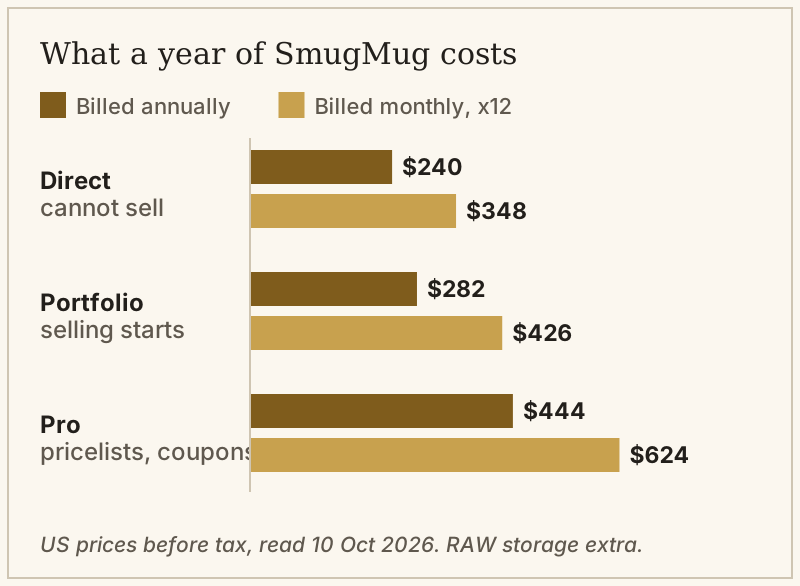
Our SmugMug review comes down to one sentence: SmugMug is the strongest photo business engine in this comparison and one of the weakest frames, and you should buy it only if selling and delivering photographs is the job. As of 10 October 2026 it costs $240, $282 or $444 a year on annual billing, there is no free plan, and on every sale it keeps 15% of the markup you add over its lab price.
Choose it if prints and downloads are a line in your accounts, if you shoot volumes that would fill anyone else's storage cap, or if your clients arrive by gallery link. Skip it if the site has to persuade an art buyer on looks alone, or if you never intend to sell, because you would be paying for a warehouse and a till you do not use.
SmugMug pricing in 2026: three plans, two billing cycles
SmugMug sells three published plans plus an Enterprise tier priced on request. We read the figures on 10 October 2026 from the plan data SmugMug's own pricing page loads for US visitors; tax is extra.
| Plan | Annual billing | Monthly billing | Annual saving | Can it sell? |
|---|---|---|---|---|
| Direct | $240 a year ($20/mo) | $29 a month ($348 a year) | 31% | No — storage, delivery and Lightroom sync only |
| Portfolio | $282 a year ($23.50/mo) | $35.50 a month ($426 a year) | 34% | Yes — prints and downloads, watermarking, lab fulfilment |
| Pro | $444 a year ($37/mo) | $52 a month ($624 a year) | 29% | Yes — plus multiple pricelists, coupons, packages |
| Enterprise | On request | On request | — | Built for studios, teams and institutions |
The annual saving is not a promotion that lapses. SmugMug's plan data shows no discount on any tier, so the $240, $282 and $444 are the prices a renewal will charge as well. That makes SmugMug unusual in this category, where first-year offers are the norm and the second invoice is the real one.
The one recurring extra is RAW storage. JPEGs are unlimited on every plan; RAW files are a separate add-on at $10 a month for up to one terabyte, then $6 a month for each additional terabyte, billed on what you actually store. A photographer archiving four terabytes of RAW would add $28 a month, which is more than the Direct plan's $20 a month on annual billing.
Affiliate link. We may earn a commission — it never moves a ranking.
Is there a free plan?
No. SmugMug offers a 14-day free trial of every feature and nothing permanent after it. The trial is enough to test uploads, build a gallery and try the client view, but it is not a way to run a portfolio for free, and the cheapest way to keep a site online afterwards is the Direct plan at $240 a year.
That answers the question people actually type, which is usually "is SmugMug free" or "how much is SmugMug a month". The honest monthly figure is $20 if you commit to a year and $29 if you do not, for a plan that cannot take an order.
The 15% of your markup, worked through
This is the section our earlier version could not complete, and SmugMug's help centre now settles it. Your profit is 85% of the difference between the price you set and SmugMug's default print price. SmugMug keeps the other 15%, and states that this 15% covers credit card payment fees, customer service and the cost of running the programme. Downloads work the same way: you keep 85% of whatever you charge above the base cost, which SmugMug sets at $0.49 for a single file and $1.99 for a whole-gallery download.
SmugMug's own worked example is a 5x7 sold for $10.79 against a default price of $0.79. The markup is $10.00 and the photographer keeps $8.50. Two things follow. The fee grows with your markup, not with your revenue, so a cheap print sold at a thin margin costs you very little. And because card processing sits inside the 15%, there is no second percentage waiting on your statement, which is not true of the platforms it competes with.
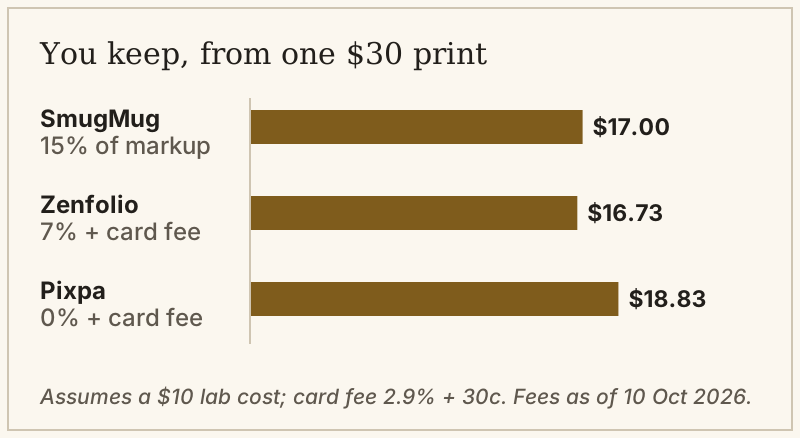
The worked comparison above uses one hypothetical sale: a $30 print whose lab base price is $10, no tax or shipping. On SmugMug the $20 markup leaves you $17.00. Zenfolio's help centre describes a 7% commerce fee on the order sub-total for Professional and Advanced subscribers, plus the processor's fee on the full order; at the Stripe rate it quotes, 2.9% plus 30 cents, the same print leaves $16.73. Pixpa charges no commission, so only the card fee comes off and $18.83 remains.
Change the numbers and the order changes. A print with a fat markup tilts the sums towards a flat percentage of the order, and a thin markup tilts them towards SmugMug. If you sell enough to care, run your own best-selling product through all three before you migrate.
Getting paid is straightforward. Profits pay out automatically in the following month once you have at least $500 unpaid; below that you can request a one-time payment from $5, or $10 for photographers outside the US. Payments run on the first business day after the 7th, by ACH in the US and PayPal elsewhere.
Unlimited, at zero compression
Most platforms that advertise unlimited storage mean unlimited after their own re-encoding. SmugMug stores full-resolution JPEGs without applying compression, on every plan including Direct, so the file a client downloads is the file you uploaded. That is the reason long-established photographers stay: a decade of shooting can live in one place without a quota email.
It also changes how the plans compare with rivals. Format meters storage by tier and Zenfolio caps it at 15 GB and 150 GB below its top plan, so on those platforms the archive lives somewhere else and the website shows a selection. On SmugMug the archive and the shop window are the same thing, which is efficient for a working photographer and irrelevant for anyone who only needs twenty-five images on a wall.
Four labs, and what happens after the order
From the Portfolio plan up, orders route automatically to WHCC, Bay Photo, EZprints or Loxley Colour. These are professional labs rather than print-on-demand marketplaces, and the difference shows up in paper, colour handling and packaging. You set the retail price and the margin; SmugMug fulfils, collects payment and handles the customer.
Four labs matter more than they sound. A lustre print, a metallic surface and a European delivery address may each be better served by a different lab, and having them behind the same checkout means you choose by job rather than by whichever single integration a platform happened to build. For event and school photographers selling to dozens of buyers per gallery, that flexibility is most of the product.
What each tier unlocks
The ladder is short and it is consequential, because the expensive mistake is buying Direct and expecting to sell.
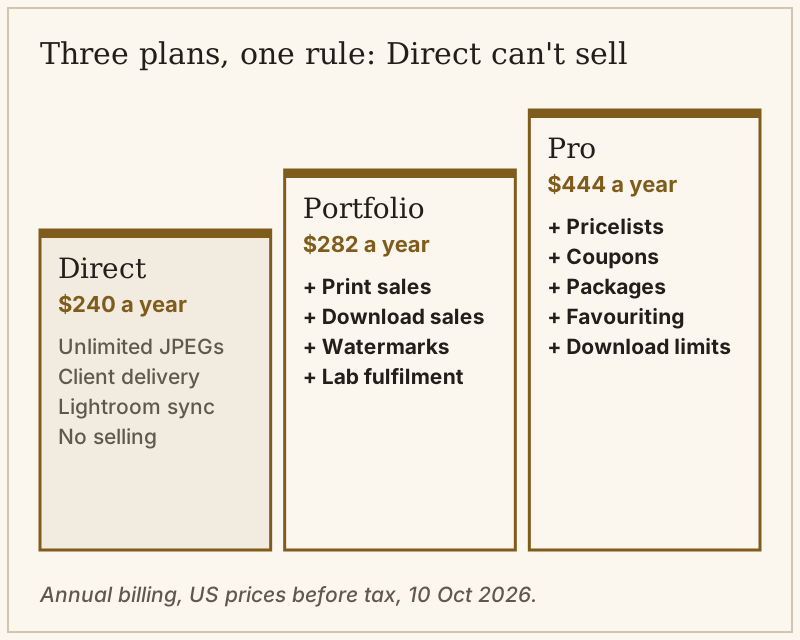
Direct is storage, privacy controls, digital delivery, Lightroom sync and round-the-clock human support. Portfolio adds print and download sales, professional templates, watermarking, profit-margin settings and full-service order fulfilment, and SmugMug's help centre confirms that you must be on Portfolio or Pro before anything can be sold. Pro adds several custom pricelists per gallery, marketing coupons and packages, and client favouriting with download limits — the tools that matter once a single wedding or school day produces hundreds of buyers.
So the realistic entry price for a selling photographer is $282 a year, not $240, and the Pro upgrade at $444 only pays for itself when per-gallery pricing and packages are part of how you sell.
Client galleries and delivery
Client galleries are a core SmugMug feature, while proofing and proof delay sit on the selling tiers. Proof delay is the quietly valuable one: it holds fulfilment for a window so a client can amend an order before it reaches the lab, which removes the most common reason for a reprint argument. Favouriting and download limits arrive on Pro.
The result is a delivery workflow shaped around what the client buys afterwards. A photographer whose contract hands over every file will find much of the machinery idle. One whose margin is in the after-sale will find nothing else here built so completely around it.
Against the cheaper options
Two alternatives come up whenever SmugMug is priced. Pixpa puts client galleries and proofing on every plan, charges no commission and fulfils through WHCC, for a fraction of the subscription; what it cannot match is unlimited storage or a choice of four labs. Zenfolio costs less in its first year and takes 7% of each order on its selling plans, which beats SmugMug on fat markups and loses on thin ones, as the chart above shows.
The decision is about volume and archive. If you shoot enough to fill terabytes and sell through several labs, SmugMug's price is rational and its fee structure is the simplest of the three. If you sell steadily from one lab and keep your archive on your own drives, you are paying for headroom you will never use. Our wider ranking of the best portfolio website builders places all eight platforms against each other rather than against this one job.
The design ceiling
This is the honest deduction, and the reason SmugMug sits third rather than first in our ranking. The templates are competent and uniform, and a SmugMug site announces itself within a scroll through its navigation and gallery behaviour. Customisation goes further than it first appears without ever removing the house accent.
For a wedding, school or sports photographer whose clients arrive by link and leave with a print, that costs nothing — nobody is grading the frame. For a photographer whose commissions come from art buyers reading the site as evidence of taste, it costs a great deal. A common arrangement is a design-led site for the public wall with SmugMug behind it for delivery and sales.
Edge cases worth checking first
A few situations change the answer. If most of your sales are digital downloads at low prices, check the $0.49 base cost against your price, because on a $3 file it is a large share. If you file taxes outside the US, payouts arrive by PayPal in your chosen currency at PayPal's exchange rate, which is a cost of its own. And if your clients want every file rather than prints, Direct's delivery tools may be all you need, at $240 a year rather than $282, because nothing on that plan is waiting to be sold.
The label
SmugMug earns its place by being excellent at the thing it is for. If prints and downloads are a real line in your income, unlimited storage, four labs and a selling fee that already includes card processing justify the highest floor in this comparison. If the site's job is to make an art director pause, you are hanging the work in a loading bay. Choose SmugMug for the business, start your 14-day SmugMug trial on the Portfolio plan if you intend to sell, and accept that the frame comes as it comes.
Catalogue notes
Is SmugMug free?
How much is SmugMug a month?
Does SmugMug take a commission on print sales?
Is SmugMug storage really unlimited?
Which SmugMug plan do I need to sell prints?
See where this sits on the wall: the best portfolio website builders, ranked — or browse portfolio examples.